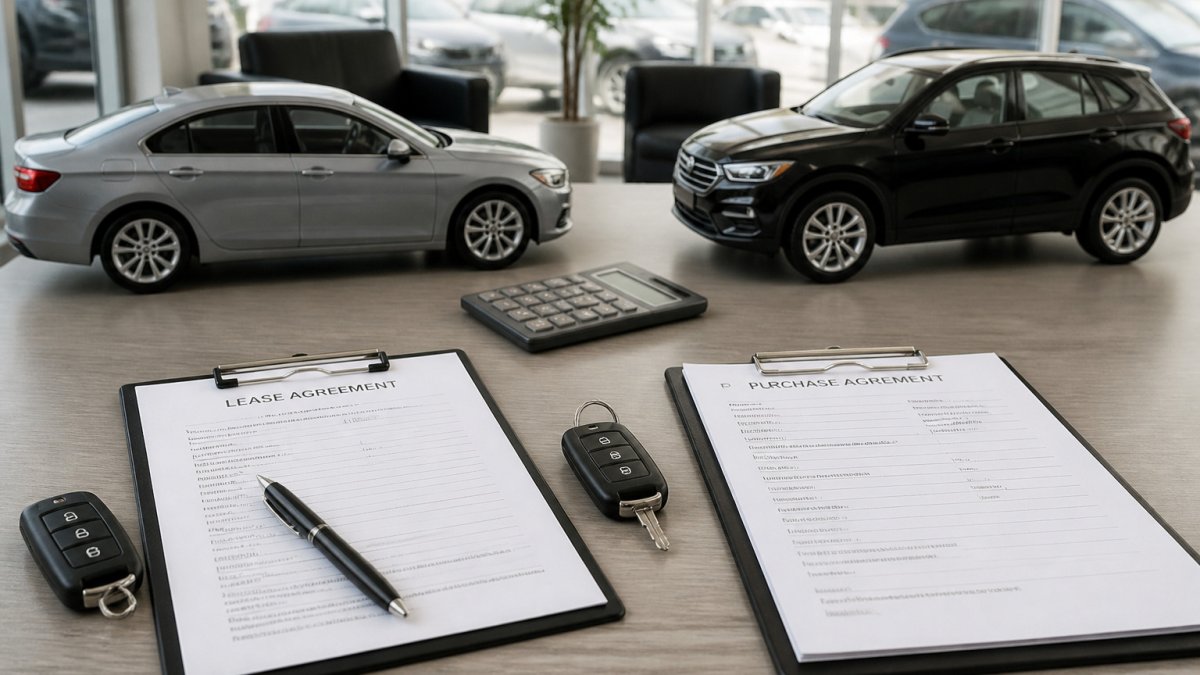
 comparison
Leasing vs Buying a Car for New Residents in Canada
Quick Summary
Leasing vs buying a car comes down to how you will pay, what you owe at the end, and whether your credit history supports the contract you want. Leasing usually means lower monthly payments and a shorter commitment, while buying builds ownership and has no mileage limits. If you expect to stay in Ontario for at least five years, buying usually costs less overall.
- Leasing usually gives lower monthly payments, but you never own the car.
- Buying carries no mileage caps, while leases often include excess-mileage charges.
- Most newcomers arrive without a Canadian credit file, which shapes how lenders approve applications.
- Confirm whether a lease can be transferred before you sign, in case you relocate.
- Compare total cost of ownership, not just the monthly payment, before you decide.
Table of Contents
- How Leasing and Buying Differ for New Residents
- Credit History, Approval and Building Credit Through a Vehicle Contract
- Monthly Payments, Upfront Costs and Total Cost of Car Ownership
- Car Lease Terms and Mileage Limits to Check Before You Sign
- Lease-End Options, Early Termination and Moving Risk
- Insurance, Registration and Taxes: The Costs Beyond the Payment
- A Practical Checklist to Decide Between Leasing and Buying
- Booking Your Next Step With Ontario Drivez
- Frequently Asked Questions
Leasing vs buying a car for new residents in Canada comes down to three things: how you will pay, what you will owe at the end, and whether your credit history supports the contract you want. The right answer depends on your income, how long you plan to stay in Ontario, and how much you drive. This guide walks through each difference so you can decide with the full picture in front of you.
Most new residents arrive without a Canadian credit file, a local employment history or a clear sense of how long they will stay in one place. Those three gaps shape the lease-or-buy decision more than the sticker price does. Below, we compare the two paths and show where each one fits.
Under a lease, you pay to use a vehicle for a set term, usually two to four years, and return it at the end. For a side-by-side look at the trade-offs, read Leasing vs Buying a Car: Pros and Cons. Under a loan, you borrow to buy the vehicle and own it once the balance is paid. The Consumer Financial Protection Bureau explains that lease payments generally do not build ownership, while the lease-end purchase option is the main route to owning the car later. CFPB guide on leasing versus buying a car
How Leasing and Buying Differ for New Residents
Leasing and buying solve different problems. A lease gives you a lower monthly payment and a newer vehicle on a shorter commitment.
Here is the basic comparison:
| Factor | Leasing | Buying (Loan) |
|---|---|---|
| Ownership | You do not own the car | You own it when the loan is paid |
| Monthly payment | Usually lower | Usually higher |
| Upfront cost | Often lower | Often higher, down payment may apply |
| Mileage | Capped, with excess charges | No limit |
| Customization | Restricted | Unrestricted |
| End of term | Return, buy out, or renew | Keep, sell, or trade in |
Pros of leasing: lower monthly payments, a newer vehicle, and less exposure to resale value. Cons of leasing: no equity, mileage limits, and wear-and-tear charges at return.
Pros of buying: ownership, no mileage caps, and freedom to keep the car for years. Cons of buying: higher payments and a larger upfront commitment, and the car loses value over time.
If you expect to stay in Ontario for at least five years and drive a predictable distance each year, buying usually costs less overall. If you are unsure where you will live next year, a lease keeps your options open.
Credit History, Approval and Building Credit Through a Vehicle Contract
Most new residents arrive without a Canadian credit file. If you have no credit score yet, see how financing a car as a newcomer without a credit score works in practice. That single fact changes how lenders read your application, and it is the part of the lease-or-buy decision that general guides skip. Here is how approval actually works, and how a vehicle contract can become a credit-building tool rather than a credit trap.
Why a thin credit file matters
Lenders in Canada typically pull a credit report from one of the two main bureaus, Equifax Canada or TransUnion Canada. If you have never borrowed in Canada, the report may be thin or empty, so the lender cannot see a repayment history. In that situation, approval usually leans on other evidence:
- Proof of income, recent pay stubs, an employment letter, or notices of assessment if you have filed a Canadian tax return.
- Residency and status documents, a study or work permit, permanent resident card, or other proof of legal status, plus proof of address.
- Banking history, a Canadian bank account with a steady deposit pattern helps more than a foreign account statement.
A common pattern is that newcomers are approved on income and documentation rather than score, and the terms reflect that risk. Ask the lender up front which documents they weight most, so you are not guessing. Our guide on which documents are needed for auto financing lists what to gather before you apply.
Does a lease or loan build credit?
Both can, but only if the lender reports the account to a credit bureau. Most major lenders and captive finance companies do report auto loans and leases, so on-time payments can start building a Canadian file. The mechanism is simple: each reported on-time payment adds positive history, and each missed payment adds a negative mark that can follow you for years.
Lease vs loan for credit building
There is no universal winner. A loan usually reports a larger balance and a longer term, which can show sustained repayment. A lease reports a smaller monthly obligation over a shorter term. What matters most is consistency: a modest contract paid on time beats an aggressive one you struggle to carry. If your income is uncertain in your first year, a shorter, lower-payment contract may be the safer credit-building choice.
Questions to ask before you apply
- Will this lender report the account to Equifax Canada or TransUnion Canada?
- Which documents will carry the most weight given my thin file?
- Is a co-signer accepted, and what does that mean for my own credit file?
Ontario Drivez works with a network of more than 30 lenders and dealership partners. We approve applications regardless of credit history, but the terms you receive still depend on your situation. Bring your income and residency documents to the conversation and ask how each option will be reported.
Monthly Payments, Upfront Costs and Total Cost of Car Ownership
The monthly payment is only one line in the cost. You can test whether a given car payment fits your budget before you commit.

Ask every lender for the total amount you will pay over the full term, not just the monthly figure. To see how dealership financing compares with bank loans, review the cost differences side by side.
Watch out: a low monthly payment stretched over a longer term often costs more in total than a higher payment over a shorter one.
Car Lease Terms and Mileage Limits to Check Before You Sign
Lease contracts set an annual mileage allowance, and going over it triggers excess-mileage charges at return. Wear-and-tear standards also apply, so dents, worn tires and interior damage can add cost.
Check the lease term length, the mileage cap, the rules for early termination, and whether you can transfer the lease if you move. Confirm in writing what happens if you exceed the allowance by a few thousand kilometres.
Lease-End Options, Early Termination and Moving Risk
For a new resident, the biggest hidden risk in a lease is not the monthly payment, it is what happens if you move again before the term ends. This section covers your end-of-lease choices, the real cost of ending early, and how a relocation affects the contract.
Your options at the end of a lease
When the term ends, you generally have three routes:
- Return the vehicle. You hand it back, pay any excess-mileage or wear-and-tear charges, and walk away. This is the cleanest exit if you are leaving the province or the country.
- Buy it out. You pay the residual value set in the contract, plus applicable taxes and fees, and own the car. This can make sense if the vehicle is worth more than the residual or you want to keep driving it.
- Renew or roll into a new lease. Some lenders and dealers offer loyalty programs, but read the terms, rolling negative equity into a new lease can raise your payment.
Early termination: the real cost
Ending a lease before the term is up is where newcomers get caught. The cost depends on the contract, but common mechanisms include:
- Paying the remaining payments for the rest of the term.
- An early-termination penalty calculated from the remaining balance or a set formula.
- Paying the difference between the vehicle's current value and the lease balance.
Some contracts allow a lease transfer, where another approved driver takes over the remaining term. This can be far cheaper than termination, but it requires the lender's approval, a credit check on the new lessee, and often a transfer fee. Ask whether transfer is allowed before you sign, not after you need it.
Moving within the province vs leaving it
A move within the province is usually manageable: update your address with the lender and insurer, and keep paying. A move out of the province or out of the country is harder. You may need to return the vehicle, sell it if you own it, or arrange a transfer. Cross-border moves can trigger registration and insurance changes, and the contract obligations generally follow you until the lease is settled.
Buying carries less relocation risk, but not none
If you buy, moving is simpler because you can sell or trade the vehicle. The catch is that owners who sell early may owe more than the car is worth if the loan balance is high. Check your loan balance against the market value before selling, and factor in any prepayment penalties.
A quick relocation check before you sign
- Can the lease be transferred, and what does it cost?
- What is the early-termination formula?
- What happens if I move out of the province or country?
Answer these before you commit, and the lease-or-buy choice becomes a decision you can reverse if your plans change.
Insurance, Registration and Taxes: The Costs Beyond the Payment
Auto insurance in Ontario is required for any vehicle you drive, and premiums vary by driving history, vehicle, age and location.
Registration fees and applicable sales tax (HST in Ontario) apply to purchases and, in many cases, to lease payments. Ontario's official vehicle registration and taxes are set by the province, so check the Government of Ontario website for current rules. Government of Ontario vehicle registration and fees
A Practical Checklist to Decide Between Leasing and Buying
Use this checklist before you apply:
- How long do I expect to stay in Ontario? Under three years points toward leasing.
- How many kilometres do I drive per year? Compare against the lease mileage cap.
- Can I afford the down payment, or does a lease fit my upfront budget better?
If most answers point toward stability and long-term use, buying is usually the stronger choice. If they point toward flexibility and lower monthly costs, a lease may suit you better.
Booking Your Next Step With Ontario Drivez
Once you know which path fits, the next step is comparing real offers. Our team can review your situation.
Give the Ontario Drivez team a call to help you achieve your goals. Give us a call at 647-467-3822 or visit us online at ontariodrivez.com.
Frequently Asked Questions
Is it better to lease or buy a car as a new resident?
It depends on how long you plan to keep the vehicle and how much you can put down. Leasing usually means lower monthly payments, but you do not build ownership, and you must stay within the mileage limit or pay excess-mileage charges. Buying costs more each month but gives you equity and the freedom to keep the car as long as you like. New residents with limited credit history should compare both options using the full cost over the term, not just the monthly figure, and confirm what approval requirements apply before committing.
Can a new resident get approved for car financing?
Approval depends on the lender's criteria, which can include income, employment, and any credit history from abroad or in Canada. Some lenders work with applicants who have little or no Canadian credit history, while others require a established file. Ontario Drivez works with a network of more than 30 lenders and partners. Gather proof of income, identification, and residency documents before you apply so the process moves faster.
What happens at the end of a car lease?
At the end of a lease you typically return the vehicle, pay any remaining balance or fees, or exercise a buyout option if your contract includes one. Returning the car may involve charges for excess mileage and for wear beyond normal use, so review those terms in your contract before signing. If you want to keep the vehicle, the buyout price is set in the agreement and may be worth comparing against the current market value. Ask the dealer or lender to explain each end-of-lease cost in writing.
Can you end a car lease early if you move?
Many leases allow early termination, but the process usually involves paying a termination fee and possibly the remaining payments, depending on your contract. Moving within Canada or leaving the country can create additional costs or complications, so check how your lease handles relocation before you go. Some lessees transfer the lease to another person, which may require lender approval. Read the early termination clause carefully and get the total cost in writing before deciding.