 listicle
Best Automatic Hatchback Cars in 2026: Buyer's Guide
Table of Contents
- Why Choose an Automatic Hatchback in 2026?
- Top Automatic Hatchbacks Compared: Specs and Features
- Hatchback vs Sedan Pros and Cons: Which Body Style Wins?
- Fuel Efficiency and Real-World Mileage for City Driving
- Safety Features and Ratings You Should Expect
- Transmission Types Explained: CVT, DSG, and Automatic
- Auto Financing for Hatchbacks: Options for Every Credit History
- Conclusion: Choosing the Right Automatic Hatchback for Your Budget
- Frequently Asked Questions
Last Updated: September 5, 2026
Why Choose an Automatic Hatchback in 2026?
The automatic hatchback has become the default choice for city driving, combining the convenience of a self-shifting gearbox with the practicality of a compact body. This guide from Ontario Drivez breaks down the best models for 2026 and how to finance one even if your credit history is less than perfect.
For Ontario buyers, the hatchback offers a rear hatch that opens to a versatile cargo area, perfect for groceries, sports gear, or a stroller. Modern automatic transmissions now deliver fuel efficiency that rivals or beats manual gearboxes. In a hatchback vs sedan pros and cons comparison, the hatchback usually wins on practicality, though sedans hold an edge in trunk security and sometimes lower insurance tiers.
Below, we'll show you how to pick the right automatic hatchback, which transmissions are most reliable, and how to secure financing that fits your budget. The key insight is that total cost of ownership, not the sticker price, should drive your decision.
Top Automatic Hatchbacks Compared: Specs and Features
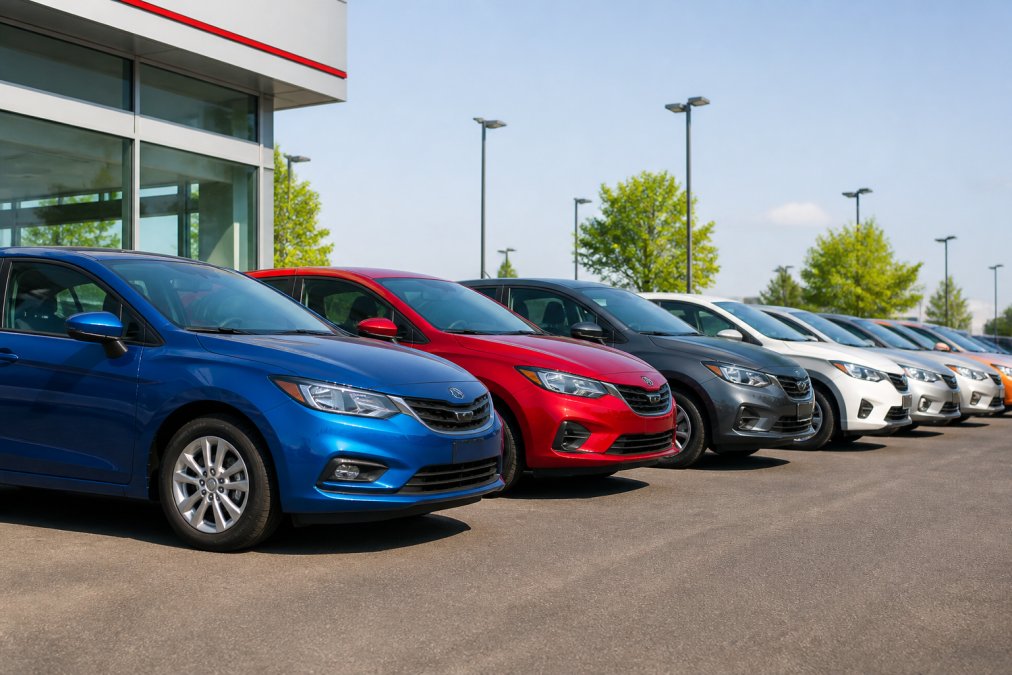
The 2026 lineup of automatic hatchback cars offers something for every priority.
Here is how the leading contenders stack up on the features that actually matter:
| Model | Transmission | Best For | Key Strength | Key Drawback |
|---|---|---|---|---|
| Honda Civic Hatchback | CVT | Commuters | Fuel efficiency, resale value | Higher starting price |
| Toyota Corolla Hatchback | Dynamic Shift-CVT | Budget buyers | Standard safety suite | Limited rear legroom |
| Mazda3 Sport | 6-speed automatic | Driving enthusiasts | Interior quality, AWD option | Smaller cargo area |
| VW Golf GTI | 7-speed DSG | Performance daily driver | Quick, precise shifts | Requires premium fuel |
| Toyota Prius | e-CVT hybrid | Eco-conscious drivers | Industry-leading fuel economy | Sloping roof cuts headroom |
| MINI Cooper 3-Door | Automatic w/ paddle shifters | Urban drivers | Nimble handling, style | Higher maintenance costs |
The Toyota Corolla Hatchback suits budget-conscious drivers prioritizing long-term reliability, though rear-seat legroom is tight. The Mazda3 Sport feels more premium than its price suggests, with upscale cabin materials and available i-Activ AWD for Ontario winters. The Golf GTI and Golf R use the quick-shifting 7-speed DSG, but the GTI needs premium fuel and the Golf R carries a high price.
Hatchback vs Sedan Pros and Cons: Which Body Style Wins?
The hatchback vs sedan debate comes down to how you use your car. A hatchback wins for versatility: the rear hatch opens wide to a tall cargo bay, and folding the 60/40 split rear seats creates space for bulky items a sedan trunk cannot swallow. Sedans offer a sealed trunk some prefer for security and typically deliver quieter cabins.
For city drivers, the hatchback's shorter rear overhang makes parking easier, and the upright tailgate improves rear visibility. The trade-off appears in the back seat: several hatchbacks, including the Corolla Hatchback, offer less rear-seat legroom than their sedan counterparts.
A common mistake is choosing based on looks alone. If you transport sports equipment, a stroller, or large grocery runs, the hatchback's flexibility is worth more than a quieter highway ride. If your cargo is mostly luggage and you value trunk security, a sedan may suit you.
Fuel Efficiency and Real-World Mileage for City Driving
Fuel efficiency is where the automatic hatchback truly shines, particularly in the hybrid segment. The Toyota Prius leads the class with industry-leading fuel economy thanks to its Hybrid Synergy Drive system, making it the strongest choice for drivers who spend hours in city traffic. The Honda Civic Hatchback and Toyota Corolla Hatchback also deliver excellent fuel economy, with the CVT tuned to keep engine revs low during steady cruising.
Window sticker figures from Natural Resources Canada's EnerGuide program are measured under idealized laboratory conditions (nrcan.gc.ca). Real-world mileage in stop-and-go city driving often differs significantly. A well-calibrated CVT keeps the engine in its most efficient range, while a traditional automatic may hunt between gears.
What Real-World Testing Shows
Across owner forums and independent Canadian reviews, the gap between official and real-world fuel economy is smallest for hybrids and largest for turbocharged engines driven aggressively. The Prius consistently achieves close to its rated consumption in urban driving because the hybrid system recaptures energy during braking. The Golf GTI often sees a 15-20% penalty in real-world city driving compared to its rating.
For the non-hybrid models in this segment, expect the following real-world city fuel economy to be approximately 1.0 to 1.5 L/100km higher than the official rating:
- Honda Civic Hatchback (CVT): Official city rating is approximately 7.0 L/100km; real-world city driving typically lands between 7.5 and 8.5 L/100km depending on traffic density and climate.
- Toyota Corolla Hatchback (Dynamic-Shift CVT): Similar to the Civic, with real-world city figures typically landing between 7.0 and 8.0 L/100km.
- Mazda3 Sport (6-speed automatic): The conventional automatic is slightly less efficient in pure city driving, with real-world figures often landing between 8.0 and 9.0 L/100km.
- Volkswagen Golf GTI (DSG): The performance-oriented tuning means real-world city driving often lands between 9.0 and 10.5 L/100km, especially in winter when cold starts and idling increase consumption.
Winter Driving and Fuel Economy
Canadian winters add a variable most American and European reviews ignore. Cold weather affects fuel economy three ways: winter-grade gasoline has less energy content, engines run less efficiently until warm, and idling to defrost burns fuel without moving. City fuel economy typically drops by 10-15% in January compared to July. Hybrids like the Prius are less affected because the electric motor handles the warm-up phase more efficiently.
The 5-Year Fuel Cost Model
Consider a 5-year ownership model based on 20,000 km per year, with 60% city driving. At $1.50 per litre, the annual fuel cost difference between a Prius (approximately 4.5 L/100km blended) and a Golf GTI (approximately 8.5 L/100km blended) is substantial. Over five years, the Prius driver saves thousands of dollars in fuel alone.
For buyers who cannot stretch to a hybrid, the Civic Hatchback and Corolla Hatchback offer the best balance of real-world efficiency and purchase price. The Prius is the clear winner for maximum fuel savings, though its sloping roofline reduces rear headroom, so taller passengers should test the back seat. The Corolla Hatchback's Dynamic Shift-CVT provides responsive acceleration while maintaining competitive fuel economy.
Safety Features and Ratings You Should Expect
Modern automatic hatchbacks come standard with a comprehensive suite of driver assistance features. The Toyota Corolla Hatchback includes Toyota Safety Sense 3.0, bundling pre-collision warning, lane departure alert, and adaptive cruise control. The Honda Civic Hatchback counters with the Honda Sensing suite across all trims.
Canadian buyers should look for a rear-view camera, mandatory on all new vehicles, plus available parking sensors and blind-spot monitoring. These features matter more in a hatchback than many realize: thick rear pillars and sloping rooflines, particularly on the Prius, can obscure visibility. The Mazda3 Sport offers available i-Activ AWD, a meaningful advantage during Ontario winters.
The Golf GTI and Civic Type R add performance-oriented safety features like upgraded brakes. For most families, the standard safety suites on the Corolla and Civic provide everything needed. Before you buy, test drive and check blind-spot visibility and parking sensor behavior in tight lots.
Transmission Types Explained: CVT, DSG, and Automatic
Understanding the transmission is the single most important decision when buying an automatic hatchback, because the gearbox determines both driving feel and the likelihood of a costly repair five years down the road. Three configurations dominate: continuously variable transmission (CVT), dual-clutch transmission (DSG or DCT), and the traditional torque-converter automatic.
Continuously Variable Transmission (CVT)
A CVT uses a belt and pulley system to provide seamless acceleration without gear shifts. It is the most fuel-efficient option, found in the Honda Civic Hatchback and Toyota Corolla Hatchback. The trade-off is a droning engine note under hard acceleration. Toyota's Dynamic Shift-CVT adds a physical first gear to improve launch feel.
Reliability and maintenance: Modern CVTs from Honda and Toyota have improved significantly. The key to longevity is strictly following the manufacturer's fluid-change interval, typically every 60,000 to 80,000 km. Neglecting this service is the most common cause of premature failure. Replacement costs are higher than a traditional automatic because the unit is sealed and often replaced rather than rebuilt.
Dual-Clutch Transmission (DSG or DCT)
A DSG uses two clutches to pre-select gears, delivering lightning-fast shifts. The Volkswagen Golf GTI and Golf R use a 7-speed DSG that feels sporty and precise. These gearboxes excel when driven enthusiastically but can feel jerky in stop-and-go traffic.
Reliability and maintenance: The DSG is the most complex and potentially most expensive transmission to maintain. Volkswagen specifies a fluid and filter change every 60,000 km, skipping it dramatically increases the risk of mechatronic unit failure, a repair that can cost thousands. In city driving, constant clutch modulation generates more heat and wear. The DSG suits drivers who prioritize performance but is the riskiest choice for a pure urban commuter.
Traditional Torque-Converter Automatic
The traditional 6-speed automatic, like the one in the Mazda3 Sport, uses a torque converter to smooth power delivery. It is the most predictable and generally the most reliable over the long term, though it sacrifices some fuel economy compared to a CVT.
Reliability and maintenance: This is the oldest and most proven technology. Torque-converter automatics are forgiving of imperfect maintenance, and independent shops are familiar with them, keeping repair costs lower. Fluid should be changed every 80,000 to 100,000 km. The main downside is a slight fuel-economy penalty and less immediate response than a DSG.
Matching the Transmission to Your Driving Style
Buyers often choose a car based on brand or body style and only discover the transmission's personality after a few weeks of ownership. To avoid that mistake, match the gearbox to your environment:
- CVT: Best for high-mileage commuters who spend hours in traffic and value fuel savings above all. The seamless power delivery is relaxing in congestion.
- DSG: Best for enthusiasts who drive on open roads and enjoy manual-style control via paddle shifters. Avoid it if your commute is mostly bumper-to-bumper.
- Torque converter: Best for buyers who plan to keep the car for 8+ years and want the lowest long-term risk of a major transmission repair.
As documented in Transport Canada's fuel consumption guide, transmission choice directly affects annual fuel costs, but the reliability difference is just as important to your total cost of ownership. A transmission that fails at 120,000 km can erase years of fuel savings in a single repair bill.
Auto Financing for Hatchbacks: Options for Every Credit History
Securing auto financing for hatchbacks does not have to end in rejection, even with imperfect credit. Traditional banks often decline applicants with past bankruptcies, collections, or no Canadian credit history. Ontario Drivez works with a network of more than 30 lenders and dealership partners to match buyers with financing that fits their situation.
The financing process starts with understanding your budget. A hatchback's lower purchase price compared to an SUV or truck means smaller monthly payments, but the interest rate on a subprime loan can stretch the total cost. Financial Consumer Agency of Canada's auto loan guidance recommends comparing the total cost of borrowing, not just the monthly payment, before signing.
Ontario Drivez offers flexible payment plans designed around your actual income, including zero-down options and no hidden fees. Whether you are new to Canada, receiving disability support, or rebuilding after a repossession, the approval process is built around your current ability to pay. The team has over 20 years of experience arranging first-time and second-chance financing.
A common mistake is assuming poor credit locks you out of choosing the car you want. That is not the case. You select the automatic hatchback that fits your needs, and the financing team handles the approval. This contrasts with programs that push whatever inventory is available, leaving buyers stuck with a vehicle that does not fit their lifestyle.
Conclusion: Choosing the Right Automatic Hatchback for Your Budget
Choosing the right automatic hatchback for 2026 comes down to matching the car's strengths to your driving habits and being honest about your budget. The Honda Civic Hatchback is the best all-rounder, the Toyota Prius is unbeatable for fuel savings, and the Mazda3 Sport offers the most premium feel per dollar. Factor in total ownership cost, including fuel, insurance, and maintenance.
Financing should not be the obstacle that keeps you from a reliable car. Ontario Drivez specializes in approvals for buyers with any credit history, offering flexible payment plans and a transparent process with no hidden fees. With over 20 years of experience and more than 30 lender partners, the team can get you into the automatic hatchback that fits your life and your budget.
Give the Ontario Drivez team a call to help you achieve your goals. Give us a call at 647-467-3822 or visit us online at ontariodrivez.com.
Frequently Asked Questions
Which automatic hatchback car is best for city driving?
For city driving, the 2026 Toyota Prius and Honda Civic Hatchback are excellent choices. The Prius offers industry-leading fuel economy with its hybrid powertrain, making it ideal for stop-and-go traffic. The Civic Hatchback provides a refined ride and a spacious interior. Both come with a CVT automatic transmission that delivers smooth acceleration. Your final choice should depend on whether you prioritize maximum fuel savings or a balance of utility and driving dynamics.
Is it easier to get auto financing for a used automatic hatchback?
Financing a used automatic hatchback can be easier on your budget because the loan amount is lower than for a new car. However, your credit history still plays a major role. At Ontario Drivez, we work with over 30 lenders to find flexible payment plans for automatic hatchbacks, regardless of whether you have a credit history, have faced bankruptcy, or are new to Canada.
What is the difference between a CVT and a DSG automatic transmission?
A CVT (continuously variable transmission) uses a belt and pulley system to provide seamless acceleration without gear shifts, which maximizes fuel efficiency. A DSG (dual-clutch transmission) uses two clutches to pre-select gears, delivering quick, precise shifts for a sportier feel. Cars like the Toyota Corolla Hatchback use a CVT, while performance models like the Volkswagen Golf GTI use a DSG. Your choice depends on whether you value fuel economy or driving engagement.
Give the Ontario Drivez team a call to help you achieve your goals. Give us a call at 647-467-3822 or visit us online at ontariodrivez.com.
This article was written using GrandRanker
Frequently Asked Questions
Q: Which automatic hatchback car is best for city driving?
A: For city driving, the 2026 Toyota Prius and Honda Civic Hatchback are excellent choices. The Prius offers industry-leading fuel economy with its hybrid powertrain, making it ideal for stop-and-go traffic. The Civic Hatchback provides a refined ride and a spacious interior. Both come with a CVT automatic transmission that delivers smooth acceleration. Your final choice should depend on whether you prioritize maximum fuel savings or a balance of utility and driving dynamics.
Q: Is it easier to get auto financing for a used automatic hatchback?
A: Financing a used automatic hatchback can be easier on your budget because the loan amount is lower than for a new car. However, your credit history still plays a major role. At Ontario Drivez, we work with over 30 lenders to find flexible payment plans for automatic hatchbacks, regardless of whether you have a credit history, have faced bankruptcy, or are new to Canada.
Q: What is the difference between a CVT and a DSG automatic transmission?
A: A CVT (continuously variable transmission) uses a belt and pulley system to provide seamless acceleration without gear shifts, which maximizes fuel efficiency. A DSG (dual-clutch transmission) uses two clutches to pre-select gears, delivering quick, precise shifts for a sportier feel. Cars like the Toyota Corolla Hatchback use a CVT, while performance models like the Volkswagen Golf GTI use a DSG. Your choice depends on whether you value fuel economy or driving engagement.