 how-to
How to Calculate Monthly Car Payments With High Interest
Last Updated: November 5, 2026
Quick Summary
To calculate monthly car payments with high interest, use the formula M = P × [r(1 + r)^n] ÷ [(1 + r)^n − 1], where P is the amount financed, r is the APR divided by 12, and n is the term in months. On a $20,000 loan over 60 months, a 20% APR produces a $530 monthly payment.
- Gather the amount financed, the quoted APR, and the loan term in months before calculating.
- Enter the APR as a decimal, since typing 7 instead of 0.07 makes the payment wildly off.
- On a $20,000 loan at 15% over 60 months, the payment is $476 and total interest is $8,560.
- Pick the shortest term you can genuinely afford rather than the longest one the lender approves.
- A co-signer with strong credit can pull your approved rate down by several tiers.
Table of Contents
- Step 1: Gather the Numbers That Drive Your Car Payments
- Step 2: Run the Math With a Car Loan Payment Calculator
- Car Payment Examples by Interest Rate: What High Rates Really Cost
- How Car Loan Term and Monthly Payment Trade Off
- Step 3: Estimate the Total Interest on a Car Loan
- Step 4: Lower Your Car Payments Without Extending the Loan
- Common Mistakes That Inflate High-Interest Car Payments
- Get a Payment Plan Built Around Your Real Budget
- Frequently Asked Questions
Step 1: Gather the Numbers That Drive Your Car Payments
Calculating monthly car payments with high interest rates starts with three numbers: the amount you borrow, the annual percentage rate, and the loan term in months. Get those wrong and every calculation after them is wrong too.
Here is what you need before you touch a calculator:
- Vehicle price after taxes and any trade-in credit
- Down payment in dollars
- Amount financed: price minus down payment
- Interest rate (APR) quoted by the lender
- Loan term in months
A common mistake is using the sticker price instead of the amount financed. That inflates your estimate and makes a bad rate look worse than it is.
If you are unsure how much payment your budget can actually carry, our guide on how to calculate car loan affordability walks through the income and expense side before you commit to a number.
Step 2: Run the Math With a Car Loan Payment Calculator
A car loan payment calculator turns your three inputs into one monthly figure. The standard formula lenders use is:
M = P × [r(1 + r)^n] ÷ [(1 + r)^n − 1]
Where M is the monthly payment, P is the principal, r is the monthly interest rate (APR divided by 12), and n is the number of months.
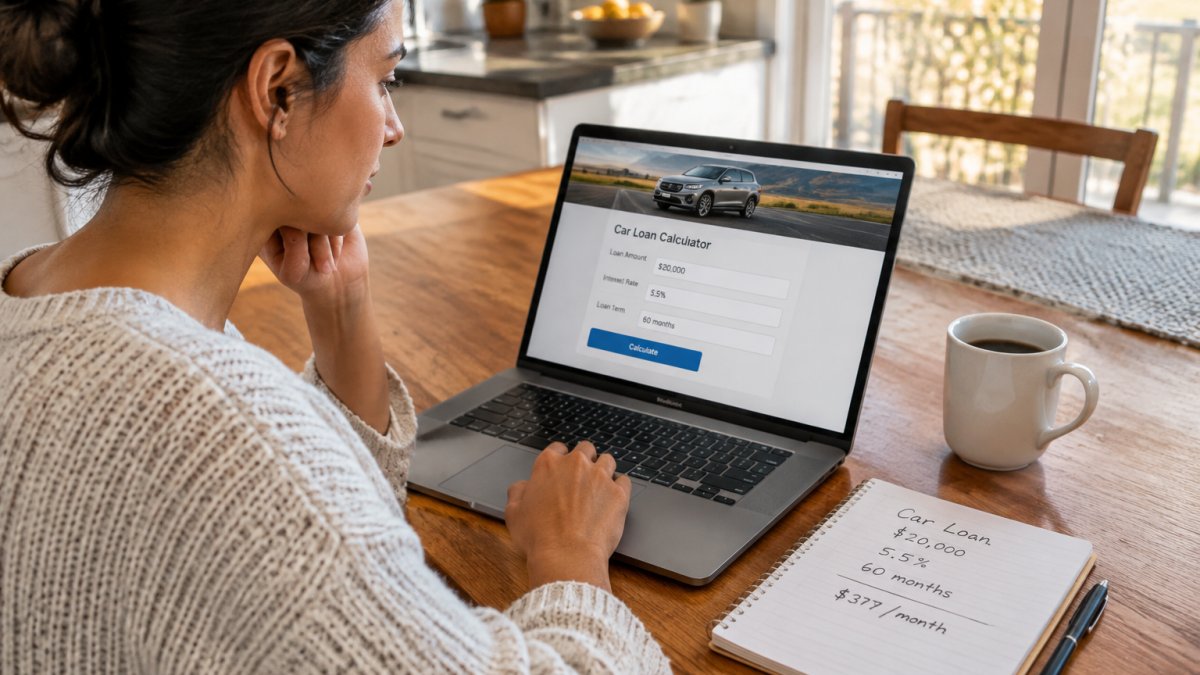
Most people skip the formula and use an online car loan payment calculator instead. That is fine, as long as you enter the APR the lender actually quoted, not the advertised rate.
Watch out: entering a rate as "7" instead of "0.07" produces a payment that is wildly off. Check your decimal before you trust the result.
Car Payment Examples by Interest Rate: What High Rates Really Cost
The gap between a low rate and a high rate is bigger than most buyers expect. On the same amount financed and the same term, a higher APR raises every single payment.
Here is how the numbers shift on a $20,000 loan over 60 months:
| APR | Monthly Payment | Total Interest Paid |
|---|---|---|
| 6% | $387 | $3,200 |
| 10% | $425 | $5,500 |
| 15% | $476 | $8,560 |
| 20% | $530 | $11,800 |
The pattern is clear. Doubling the rate from 10% to 20% adds roughly $105 a month and more than doubles the interest you pay over the life of the loan.
These car payment examples by interest rate show why shopping your rate matters as much as shopping the vehicle. A subprime lender may approve you at a higher APR, but you should still ask what drives that number.
How Car Loan Term and Monthly Payment Trade Off
Stretching the loan term lowers the monthly payment. It also raises the total interest, and that trade-off is where a lot of buyers get hurt. The mechanism is simple: a longer term spreads the principal over more months, so each payment carries less principal and more of the balance sits accruing interest for longer. You pay more overall and stay upside down on the vehicle longer.
Here is what the trade-off looks like on a $20,000 loan at 15% APR, the kind of rate a high-interest borrower may be quoted:
| Term | Monthly Payment | Total Interest Paid |
|---|---|---|
| 36 months | $693 | $4,950 |
| 48 months | $557 | $6,730 |
| 60 months | $476 | $8,560 |
| 72 months | $423 | $10,430 |
| 84 months | $386 | $12,420 |
Going from a shorter term to a longer one cuts the payment by roughly $307 a month, but it adds about $7,470 in interest and keeps you in a negative-equity position for years. On a vehicle that depreciates, that is the worst possible combination.
There is a second cost most buyers never see: the negative equity trap. If you owe more than the vehicle is worth when you trade it in, the shortfall gets rolled into the next loan, which means you are financing a car you no longer drive. On a long term at a high rate, that gap widens before it closes.
Our breakdown of your car loan amortization schedule shows exactly how each payment splits between interest and principal as the term runs, so you can see the crossover point where you finally owe less than the vehicle is worth.
The rule we recommend: pick the shortest term you can genuinely afford, not the longest one the lender will approve. A 48-month term at a rate you can handle beats an 84-month term that keeps you underwater.
Watch out: a dealer can make almost any payment fit your budget by stretching the term. If the only way the payment works is an 84-month loan on a used vehicle, the vehicle is too expensive for your situation, not the loan too short.
Step 3: Estimate the Total Interest on a Car Loan
Total interest on a car loan is the sum of every payment minus the amount you borrowed. It is the real cost of financing, and it is the number high-rate borrowers most often ignore.
To estimate it:
- Multiply your monthly payment by the number of months
- Subtract the amount financed
- The result is your total interest
If you want the full walkthrough of the math, our article on how to calculate total interest on a car loan breaks it down step by step so you can check your own figures.
Step 4: Lower Your Car Payments Without Extending the Loan
You can shrink a high-interest payment without stretching the term. The lever is the amount you borrow and the rate you are charged, not the number of months. Here is how each lever actually moves the math on a $20,000 loan at 15% over 60 months, where the payment is $476 and total interest is $8,560.
Increase your down payment. Every dollar down cuts the principal and the interest it would have earned. Putting more money down reduces the amount financed, which lowers both the payment and the total interest. The down payment is also the single biggest approval factor for high-rate borrowers, because it reduces the lender's loss if the loan defaults.
Choose a less expensive vehicle. A smaller loan at the same rate means a smaller payment. A less expensive vehicle means a smaller loan and a smaller payment at the same rate. On high-rate loans, the vehicle price matters more than the rate negotiation, because you are paying interest on every dollar of depreciation.
Improve your credit before you apply. Even a modest score gain can move you into a better rate tier. A lower rate reduces both the payment and the total interest. The catch is timing: rate shopping within a short window is treated as a single inquiry by most scoring models, so do your applications together rather than spreading them over months.
Add a co-signer with strong credit. This is the lever most guides skip, and it is often the most powerful one. A co-signer with a strong score can pull the approved rate down by several tiers, because the lender is underwriting the co-signer's credit as well as yours. A lower rate from a strong co-signer can meaningfully reduce both the payment and the total interest.
Refinance later. Once your credit improves and you have made a run of on-time payments, refinancing can replace a high rate with a lower one. The math only works if the new rate is low enough to recover the cost of switching and you are not extending the term back out. Refinancing a 60-month loan at month 18 into a new 60-month loan resets the clock and can leave you paying interest longer than you planned.
Our guide on using a down payment to lower monthly car payments covers how much to put down and how it changes the math.
Watch out: a co-signer lowers the rate but does not lower your obligation. If the co-signer is the only reason for approval, the lender is pricing the loan on their credit, not yours, and a single missed payment can damage both credit files at once.
Common Mistakes That Inflate High-Interest Car Payments
The biggest mistake is focusing on the monthly payment alone, since stretching the term can make almost any payment look affordable while you pay far more in interest.
Other errors we see often:
- Accepting the first rate offered without checking lending criteria elsewhere
- Skipping the total interest calculation entirely
- Rolling negative equity from an old loan into a new one
- Ignoring the cost of insurance and maintenance in the budget
- Signing without reading the reaffirmation agreement or contract terms
Predatory lending thrives on buyers who only ask "what's the payment?" Ask "what's the total cost?" instead.
For a wider checklist of financing missteps, read are you making these car financing mistakes.
Get a Payment Plan Built Around Your Real Budget
A high interest rate does not have to mean an unaffordable payment. Run the numbers first, then build a plan around what you can actually carry each month.
At Ontario Drivez, we work with more than 30 lenders and partners to find financing that fits your situation, whatever your credit history looks like. We offer flexible payment plans, zero-down options, and transparent, no-hidden-fee service. Our team has over 20 years of experience helping people get back on the road, whether you are rebuilding after bankruptcy, new to the country, or simply need a fresh start.
Give the Ontario Drivez team a call to help you achieve your goals. Give us a call at 647-467-3822 or visit us online at ontariodrivez.com.
Frequently Asked Questions
How do I calculate a monthly car payment with a high interest rate?
Use the standard amortization formula: M = P × [r(1+r)^n] / [(1+r)^n - 1], where P is the amount financed, r is the monthly interest rate (annual rate divided by 12), and n is the number of monthly payments. For example, financing $20,000 at 15% for 60 months means r = 0.0125 and n = 60, giving a monthly car payment of about $476. A car loan payment calculator does this instantly and lets you test different rates and terms side by side.
How much does a higher interest rate add to a car payment?
On a $20,000 loan over 60 months, moving from 7% to 15% raises the monthly payment from roughly $396 to about $476, an extra $80 per month. Over the full term that difference adds up to thousands in extra interest. The gap widens on longer terms because you pay the higher rate for more months. Always compare car payment examples by interest rate before signing, and ask what APR you qualify for, not just the advertised rate.
Does a longer car loan term lower monthly payments?
Yes, stretching the term lowers the monthly car payment, but it raises the total interest you pay. A $20,000 loan at 12% costs about $445 per month over 60 months but about $381 over 72 months. The 72-month option saves roughly $64 monthly yet adds hundreds in interest overall and keeps you upside down on the vehicle longer. Shorter terms cost more per month but reduce the total interest on a car loan and help you build equity faster.
How can I reduce the total cost of a high-interest car loan?
Make a larger down payment to shrink the amount financed, choose the shortest term you can afford, and make extra payments toward the principal when possible. Improving your credit score before applying, even by a few points, can move you into a lower rate tier. Avoid add-ons rolled into the loan and check that the rate quoted matches the contract. A subprime lender that reports to credit bureaus also helps you rebuild credit history for refinancing later.