 comparison
Car Loan Requirements for Permanent Residents
Table of Contents
- Car Loan Requirements for Permanent Residents vs. Citizens: Key Differences
- Eligibility Criteria and Credit History Impact
- Documents Needed for Car Financing in Canada
- Auto Financing for Work Permit Holders and Newcomers
- Down Payment Requirements and Loan Terms
- Building Credit in Canada for Auto Loans
- How to Apply for an Auto Loan as a Permanent Resident
- Frequently Asked Questions
Last Updated: September 19, 2026
Car Loan Requirements for Permanent Residents vs. Citizens: Key Differences
Permanent residents and Canadian citizens face different hurdles when applying for auto financing, and understanding car loan requirements permanent residents must meet, differences that can mean approval versus rejection, or reasonable rates versus premium ones. Understanding these distinctions upfront saves time, frustration, and money.
Lenders treat permanent residents differently because they carry different risk profiles than citizens. A permanent resident could theoretically leave the country; a citizen can't. That single fact shapes every requirement a lender will impose.
This guide breaks down what lenders look for, which documents matter most, and how permanent residents can strengthen their applications to move from application to approval.
Eligibility Criteria and Credit History Impact
To qualify for an auto loan in Canada, you need legal residency status, proof of income, and a credit history. Permanent residents meet the first requirement; the other two are where things get complicated.
Credit history is the biggest factor. Most traditional lenders want a credit score of 620 or higher. Permanent residents arriving from overseas have zero Canadian credit history, different from bad credit. Lenders can't see your payment history abroad and are starting from scratch.
Citizens and permanent residents are treated identically on credit score thresholds. The difference emerges when you lack a score. Both can build credit through student lines, co-signs, or secured cards, but permanent residents often have fewer years to do so before needing a car.
This is where the permanent resident disadvantage shows up: time pressure. Many newcomers need reliable transportation immediately for work but haven't had years to build credit. Lenders assume 2-3 years of credit establishment; permanent residents often haven't.
Some lenders apply a "recency premium", charging higher interest rates to permanent residents with short Canadian credit histories, even with strong income and employment. It's risk-based pricing: a permanent resident with 6 months of credit history will pay more than a citizen with the same income and 3 years of history.
Documents Needed for Car Financing in Canada
Lenders require proof of identity, residency, and income. Documents differ slightly for permanent residents versus citizens.
Identity and residency documents:
- A valid passport or travel document
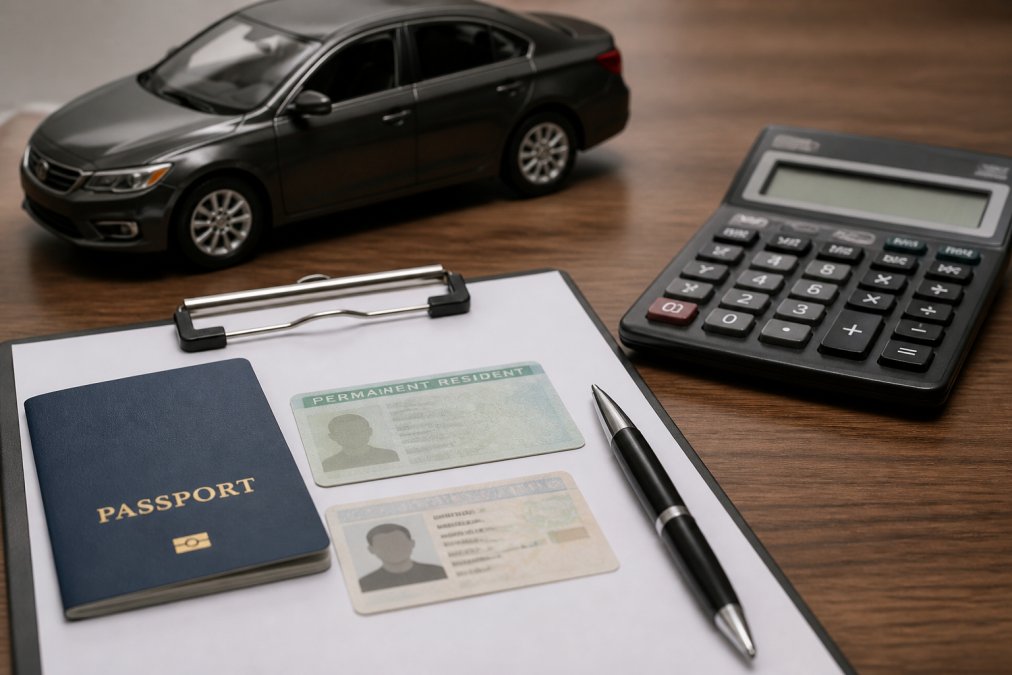
- A Permanent Resident Card (if you have one) or a confirmation of permanent residence letter from Immigration, Refugees and Citizenship Canada
- A valid driver's license (provincial or territorial)
- Two pieces of proof of residency (utility bill, lease agreement, or mortgage statement dated within the last 90 days)
Citizens skip the permanent residency confirmation, the main difference.
Proof of income:
- Recent pay stubs (typically the last 2-3 months)
- An employment letter from your employer confirming your position, salary, and employment start date
- For self-employed permanent residents: two years of tax returns and financial statements
- Bank statements showing regular deposits (helps if your employment is recent or irregular)
Credit documentation:
- A credit report (the lender usually pulls this, but you can obtain one yourself from Equifax or TransUnion)
- For permanent residents with no Canadian credit history: a letter from your previous country's financial institution showing your payment history (optional, but helpful)
The employment letter is critical for permanent residents. It must confirm you're a permanent resident working legally in Canada. A generic letter without residency confirmation is weaker than one explicitly stating you're authorized to work.
Auto Financing for Work Permit Holders and Newcomers
Work permit holders occupy a different category. A work permit is temporary; permanent residency is indefinite. That distinction matters enormously to lenders.
Most mainstream lenders won't approve work permit holders. A work permit can expire or not be renewed, meaning you could stop earning income and leave within 12 months, unacceptable risk for a 5-7 year loan.
Some lenders will approve work permit holders if the permit is valid for 2-3+ more years, your employer is large and stable, you have a Canadian citizen or permanent resident co-signer, or you accept a premium interest rate.
Permanent residents have a significant advantage: your residency status is permanent, not on a countdown. Lenders treat you as a long-term resident, opening doors that close for work permit holders.
For newcomers on work permits, the practical path is a co-signer or specialized lender. A co-signer who is a Canadian citizen or permanent resident with good credit can unlock financing options that wouldn't otherwise exist.
The cost is the co-signer's responsibility. If you miss a payment, the lender pursues the co-signer. Ensure your co-signer understands the risk.
Down Payment Requirements and Loan Terms
Car loan requirements permanent residents must satisfy regarding down payments differ from those for citizens.
Traditional lenders typically require 10-20% down. A permanent resident with strong credit and employment can qualify with 10% down, like a citizen. Limited Canadian credit history often requires 15-20% down, as lenders use down payment as a risk cushion.
Zero-down financing is rarely available for permanent residents without established credit. When possible, you'll pay higher interest rates and face stricter employment verification.
Loan terms typically range from 36 to 84 months. Strong credit may qualify for 60 months; limited history often requires 72-84 months, lowering monthly payments but increasing total interest.
Lenders may extend amortization to lower monthly payments, especially useful if you're newly employed or in a lower-paid role while establishing yourself in Canada.
Building Credit in Canada for Auto Loans
Permanent residents without Canadian credit history need a strategy. You can't get a car loan without credit, but you can't build credit without using credit. The cycle is real.
The fastest path to auto loan approval:
- Open a Canadian bank account and use it for 1-2 months to establish banking history
- Apply for a secured credit card (backed by a deposit, usually $500-$2,000)
- Use the card for small, regular purchases (groceries, gas, utilities)
- Pay the full balance every month, on time
- After 6 months, apply for an unsecured credit card
- After 12 months of solid payment history, you'll qualify for better auto loan rates
This timeline is realistic. You can't compress it much further. Credit bureaus need time to see patterns. Six months of perfect payments is the minimum threshold where lenders start trusting you.
Parallel strategy, build employment history. Lenders care about income stability as much as credit history. If you're in a new job, stay for at least 6 months before applying for an auto loan. If you can stay for a year, even better. A permanent resident with 12 months of employment history and 6 months of credit history is significantly more attractive than one with 3 months of each.
Co-signer advantage. A co-signer with strong credit can accelerate your approval by months. You don't need to wait for your own credit history to mature. Your co-signer's history becomes part of the application. This is especially valuable for newcomers who need a vehicle urgently.
The cost of a co-signer is psychological, not financial. You pay the same interest rate. But the co-signer is legally responsible if you default. Choose someone you trust completely, and make every payment on time. Missing payments damages both your credit and theirs.
How to Apply for an Auto Loan as a Permanent Resident
The application process for permanent residents is nearly identical to the citizen process. The difference is in the documents and the scrutiny.

Step 1: Gather your documents. Collect everything listed in the "Documents Needed" section above. Don't skip anything. A complete file moves faster.
Step 2: Check your credit report. Pull your own credit report from Equifax or TransUnion before applying. Look for errors. If you find a mistake (a missed payment you actually made, an account that isn't yours), dispute it immediately. Lenders will see the same report. Fixing errors now prevents delays later.
Step 3: Determine your budget. Know the maximum monthly payment you can afford. Work backwards to your loan amount. If you can afford $350/month for 60 months, that's roughly a $18,000-$19,000 loan (depending on interest rate). Don't apply for more than you can actually pay.
Step 4: Choose a lender. You have three options: a traditional bank, a credit union, or a specialized lender. Traditional banks are cheapest if you have good credit. Credit unions are more flexible with permanent residents.
| Application Step | Timeline | Key Requirement |
|---|---|---|
| Document gathering | 1-2 days | Complete file with residency proof |
| Credit check | 1 day | No disputes or errors on report |
| Pre-approval | 1-3 days | Employment and income verification |
| Vehicle selection | 3-7 days | Vehicle must meet lender standards |
| Final approval | 1-2 days | Employment confirmation |
| Funding and signing | 1 day | Insurance and registration complete |
| Total | 1-2 weeks | Permanent residency documentation |
Frequently Asked Questions
Can I get a car loan without a Canadian credit history?
Yes. Permanent residents without Canadian credit history can qualify for auto financing through lenders who specialize in newcomer programs. These lenders evaluate proof of income, employment letters, and residency documentation instead of relying solely on credit scores. Many accept recent immigrants and work permit holders. Your proof of income and stable employment are often more important than a credit report when you're new to Canada.
What documents are required for permanent residents to secure auto financing?
Permanent residents typically need a valid driver's license, proof of residency (utility bills or lease agreement), proof of income (recent pay stubs or employment letter), a completed financing application, and proof of Canadian residency status. Some lenders also request bank statements and references. Having all documents organized before applying speeds up the approval process significantly.
Do permanent residents face different interest rates compared to citizens?
Interest rates depend primarily on credit history, debt-to-income ratio, and loan term rather than residency status alone. Permanent residents with established credit histories may receive rates similar to citizens. However, newcomers without Canadian credit may see higher rates initially. Building credit through timely payments on your auto loan helps you qualify for better rates on future refinancing.
Is a down payment mandatory for permanent residents seeking auto loans?
Down payments are not always mandatory. Many lenders offer zero-down financing options for permanent residents, though this may affect your interest rate and monthly payments. A larger down payment typically lowers your loan amount and monthly installments. Your specific down payment requirement depends on the lender, your credit profile, and the vehicle you choose.