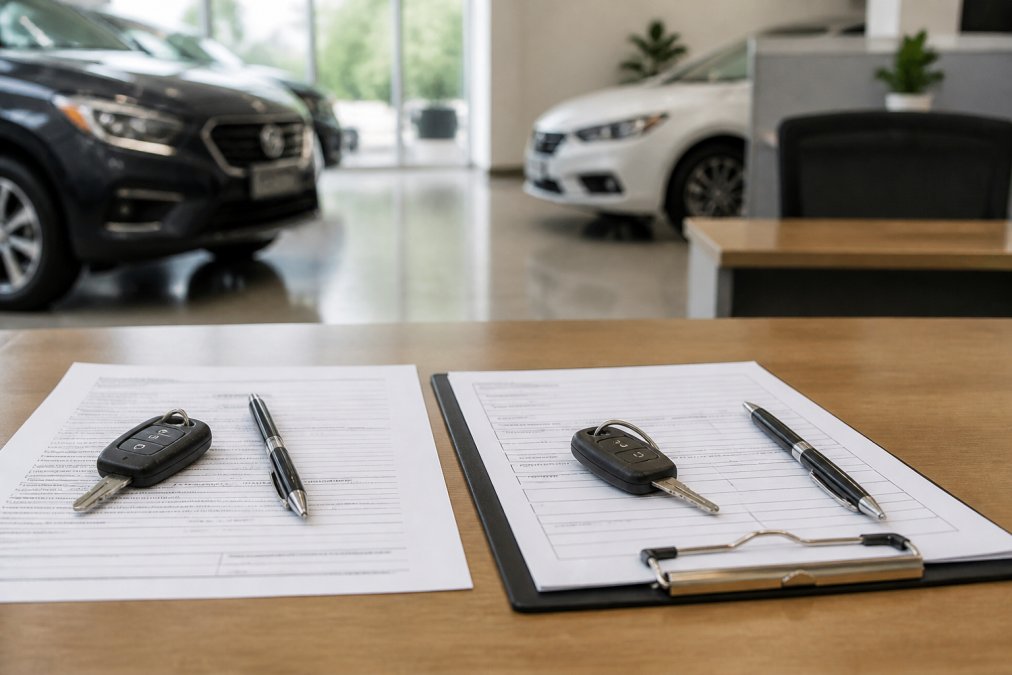
 comparison
Bad Credit Auto Loan vs Dealership Financing
Table of Contents
- Bad Credit Auto Loan vs Dealership Financing: Quick Comparison
- How Bad Credit Auto Loans Work
- Understanding Dealership Financing for Bad Credit
- Bad Credit Car Loan Interest Rates: What You'll Actually Pay
- Auto Loan Approval Requirements and Credit Score Impact
- Zero Down Payment Car Financing Options
- Total Cost of Ownership: Bank Loans vs Dealer Financing
- Pre-Approval vs Pre-Qualification: What's the Real Difference
- Frequently Asked Questions
Last Updated: September 19, 2026
Bad Credit Auto Loan vs Dealership Financing: Quick Comparison
When your credit score has taken a hit, finding vehicle financing feels impossible. Most traditional banks reject applications outright. But two main paths exist: securing a bad credit auto loan from specialized lenders, or working with dealership financing programs designed for borrowers with poor credit histories. Understanding the differences between these options is crucial because they affect not only whether you get approved, but how much you'll ultimately pay and what flexibility you'll have if your financial situation changes.
Each path has genuine advantages and real drawbacks that matter to your wallet and your peace of mind.

Bank and credit union loans typically offer lower interest rates but stricter approval requirements. Dealership financing moves faster and approves almost anyone, but costs more. The right choice depends on your credit score, down payment capacity, and approval timeline.
| Financing Type | Approval Speed | Interest Rate Range | Down Payment Required | Best For |
|---|---|---|---|---|
| Bank/Credit Union Loan | 3-7 days | Varies by credit | Often required | Borrowers with some credit history |
| Dealership Financing | 1-2 days | Typically higher | Zero-down options available | Fast approval, flexible down payment |
How Bad Credit Auto Loans Work
A bad credit auto loan is an installment loan for borrowers whose credit scores fall below prime thresholds. The lender assumes higher risk, reflected in the interest rate and loan structure.
The process starts with a hard credit inquiry. The lender reviews your credit history, income, employment stability, and debt-to-income ratio to assess whether you can realistically make monthly payments.
Approval typically takes three to seven business days. Once approved, you receive a loan offer with the principal, rate, term, and monthly payment, then shop for a vehicle independently without dealership restrictions.
Your vehicle serves as collateral, which is why lenders approve borrowers with poor credit. If you default, the lender can repossess the vehicle to recover losses.
You build credit history with every on-time payment. After 12-24 months of consistent payments, your credit score typically improves enough to refinance at a better rate.
Understanding Dealership Financing for Bad Credit
Dealership financing works differently. The dealership connects you with lenders from their network and acts as an intermediary, handling paperwork and managing the relationship.
The speed is the headline advantage. Many dealerships approve you the same day you walk in, which matters for those needing transportation urgently.
Dealership financing typically carries higher interest rates than bank loans. Dealerships work with subprime lenders and markup rates to earn profit through a "dealer reserve," which isn't disclosed on your contract.
Dealerships offer zero-down financing, but your loan-to-value ratio is higher, meaning you owe more than the vehicle is worth. If the car is totaled early, you could owe thousands with no recovery.
Dealerships handle paperwork and often sell the loan to another company shortly after purchase. You'll receive notices to send payments to a different servicer, creating distance if problems arise.
Bad Credit Car Loan Interest Rates: What You'll Actually Pay
Interest rates vary widely based on credit profile, employment stability, income level, and down payment size.
Bank and credit union loans for bad credit borrowers typically range from 9% to 29% APR. Dealership financing often falls in the 15% to 35% range. These rates directly impact your monthly payment and total cost.
The difference between a 12% rate and an 18% rate on a $20,000 loan over 60 months is substantial. At 12%, your monthly payment is approximately $445. At 18%, it jumps to $482 per month. Over the life of the loan, you'll pay roughly $2,700 more in interest alone. That's real money that could go toward vehicle maintenance, insurance, or savings.
Stable employment history (at least two years) signals reliability. Recent job changes, gaps, or seasonal work increase perceived risk. Lenders want confidence you can afford payments without strain.
A 36-month loan means higher monthly payments but lower total interest. A 72 or 84-month loan lowers monthly payments but dramatically increases total interest paid.
Auto Loan Approval Requirements and Credit Score Impact
Traditional banks typically want scores of 620 or higher. Credit unions may accept scores of 550. Dealerships and subprime lenders often have no stated minimum.
Your credit report itself matters as much as your score. Lenders examine the pattern of your credit behavior. A single missed payment from two years ago, recovered since then, looks different than recent collections or a recent bankruptcy. Recent negative marks, within the last 12 months, trigger higher rates or outright rejections. Older negative marks lose impact over time.
Employment history is non-negotiable. Most lenders require a minimum of two years at your current job or in your current field. Self-employed borrowers face stricter scrutiny and need two years of tax returns showing consistent income. If you've changed jobs recently, be prepared to explain why and demonstrate that your new position is stable.
Income verification is straightforward: recent pay stubs, tax returns, or employment letters. Some lenders accept alternative income sources, disability support payments, child support, rental income, or investment returns. The key is proving the income is stable and likely to continue. Lenders also calculate your debt-to-income ratio, which compares your total monthly debt obligations to your gross monthly income. Ratios above 50% often trigger rejection or higher rates.
The application itself triggers a hard credit inquiry, which temporarily lowers your score by 5-10 points. Multiple inquiries within a short window (typically two weeks) count as a single inquiry for scoring purposes, so shopping around doesn't multiply the damage. However, each inquiry from a different lender adds up if they're spread across months.
Zero Down Payment Car Financing Options
Zero-down financing appeals to borrowers with limited savings, and dealerships aggressively market these programs. The appeal is obvious: drive home in a new vehicle without scraping together thousands for a down payment. But the mechanics of zero-down financing create real risks.
When you put nothing down, your loan-to-value ratio is 100% or higher. You're borrowing the full purchase price, or even more if the dealership adds fees and dealer reserve charges.
Total Cost of Ownership: Bank Loans vs Dealer Financing
Comparing a bank loan to dealership financing requires looking beyond the monthly payment. Total cost of ownership includes the interest paid over the loan's life, fees, insurance, maintenance, and fuel. Two borrowers with the same vehicle and monthly payment can have vastly different total costs depending on their financing choice.
Pre-Approval vs Pre-Qualification: What's the Real Difference
These terms are often used interchangeably, but they mean different things and carry different weight in your financing process.
Frequently Asked Questions
Is it better to get a bad credit auto loan from a bank or through dealership financing?
Bank-based bad credit auto loans typically offer lower annual percentage rates and more transparent terms, but dealership financing often approves applicants with lower credit scores or minimal credit history. Bank loans require stronger credit profiles and longer application processes. Dealership financing moves faster but may include dealer markup and higher interest rates. Your choice depends on your credit score, down payment capacity, and timeline. With a credit score below 550, dealership financing may be your only viable option. For scores above 600, comparing both paths through pre-approval can reveal which lender offers better amortization terms and lower total interest costs.
What auto loan approval requirements apply to someone with bad credit?
Most lenders require proof of income, a valid driver's license, and a credit report check. Traditional banks typically want a credit score above 620, stable employment history, and a debt-to-income ratio below 43%. Bad credit specialists and dealership lenders are more flexible: some approve applicants with scores as low as 500, accept alternative income documentation (disability support, child tax benefits), and focus more on current income than past defaults. However, all lenders assess default risk through your credit bureau records. Expect a hard credit inquiry to appear on your report. Having a co-signer or larger down payment strengthens approval odds across all lending channels.
How much higher are bad credit car loan interest rates compared to prime lending?
Bad credit car loan interest rates vary significantly based on credit score, loan term, and lender type. Borrowers with scores above 650 may qualify for rates in the 6-10% range. Those between 550-650 typically see 10-18% annual percentage rates. Scores below 550 can face rates between 15-25% or higher, particularly through dealership financing. Dealer reserve practices may add an additional 1-3% markup. Loan term length affects total interest: a 72-month loan at 18% costs substantially more in total interest than a 48-month loan at the same rate. Secured loans (where the vehicle is collateral) generally carry lower rates than unsecured options because the lender's default risk is reduced.
Can I get zero down payment car financing with bad credit?
Yes, zero down payment car financing is available for bad credit borrowers, but approval depends on your credit score, income stability, and the lender. Dealership financing commonly offers zero-down options because the vehicle serves as collateral, lowering the lender's default risk. Bank and credit union lenders rarely approve zero-down without a credit score above 650 or a co-signer. Zero-down financing typically results in higher monthly payments and longer loan terms (60-84 months), which increases total interest paid. Your loan-to-value ratio will be 100%, meaning you owe the full vehicle price. This structure works best if you need immediate transportation and can afford higher monthly installments. Compare the total cost against putting down 10-20% if you have savings available.
What is the dealer reserve, and how does it affect my financing cost?
The dealer reserve is the difference between the interest rate the lender approves and the rate the dealer charges you. When a lender approves you at 12% annual percentage rate, the dealer may mark it up to 14-15%, keeping the difference as profit. This practice is legal but often undisclosed. Dealer reserves can add thousands to your total financing cost over the loan term. Before signing, ask the dealer to disclose the lender's approved rate and confirm the rate you're agreeing to. Comparing pre-approval offers from banks or credit unions before visiting a dealership gives you leverage to negotiate or walk away. Some dealers are transparent about reserves; others bury them in complex financing agreements. Always request the financing agreement in writing before signing.